INSIGHT YOKESEN
Notes on AI, business execution, and the technology actually used.
Category

No doubt about it! Indonesia is mobile-first, currently there are more cellular connections (345.2 million people) than its recorded population (273.5 million people) in March 2021.
And Indonesian consumers spend an average of eight (8) hours or more per day surfing the internet via their gadgets (mobile first). Three (3) hours of which are on various existing social media.
It is not surprising that 67% of Indonesians purchase all their daily needs via their smartphone. And most brands are just starting to learn how to enter this massive, large (and very complex) market. Own and manage multiple online stores
In a research by Alvara 2019, it was stated that the nine main behaviors of the Indonesian millennial generation, namely Internet addiction, low loyalty, cashless, smart and fast work, multitasking, likes to travel, is indifferent to politics, likes to share, and finally low ownership of goods.
The internet has become a primary need for people in Indonesia. Almost all activities require internet support, such as browsing, chatting, road map directions, transportation services, and online donations. Data from the Internet Service Providers Association (APJII) in May 2019, the number of internet users in Indonesia grew 10.12%, from 2017 which reached 54.85% in less than 2 years.
Consumers move from one gadget to another, from one channel to another, and cross over between the online and offline worlds. An omnichannel strategy that involves marketplace integration as an ecommerce solution requires support from marketplace enablers. Multiplatform integration and payment gateway integration make it easier to move data streams and transactions.
Omnichannel solutions with multiplatform integration such as marketplaces and social media, not only make it easier for businesses to control data flow, payment flow and also the movement of consumers from platform to platform in their consumer experience journey with the brand
Also read My Starbucks Card Data-Driven Omnichannel Strategy for another case study in implementing marketplace integration as an omnichannel solution.
Sep 30, 2021

Consumers are now ONLY interested in brands or product/service providers that are able to provide answers that are easiest and fastest to find digitally.
In a Forrester research (2019) in marketing and advertising, a brand must focus on three main aspects, namely:
- Identify key moments when the "intention" of the consumer appears
- Fulfill consumer needs when key moments appear or occur
- Measure all the key moments,
Where all three refer to the main #objectives to create relevant and useful customer experiences in every interaction in the consumer's #userjourney to make a purchase.
*) "the right moments" - what we mean are the moments when consumers reflexively turn to their gadgets, act based on their needs, to search for information, explore, discover, choose and buy something.
Also read what The main key to a high conversion rate landing page
Sep 29, 2021

What are the real factors that make buyers want to keep buying on eBay and continuing to buy?
For buyers, the genius thing about the #eBay platform is that when you buy something there, you don't just buy something or shop online (as is the case on other eCommerce platforms).
On E-Bay, buyers feel that they have just gotten some valuable item because they bid for the best price in fighting for ownership of an item. The buyer feels like he has WON!
After several adrenaline-fueled bidding battles, buyers may end up paying 10% more than they would have on the market, but they feel like they have achieved victory over dozens of others who were also bidding against them! And the value of that #happiness far outweighs the extra money they end up paying for the item.
EBay was one of the first #Commerce companies to build gamification into its core DNA.
How your brand can apply gamification to help increase sales and consumer participation? Also read how Yokesen's Gamification Strategy helps businesses from various types of industries.
Sep 29, 2021

“One dies, a thousand grows.”
When one business experiences a downturn, at the same time businesses operating in the same field emerge to the surface.
The inefficiency of old-fashioned business processes, or read: untouched by #digitalization #technology can have quite a big impact without business people realizing it. For example, like:
- Slow business operations and business decision making result in ineffective performance.
- Too much employee work time is wasted without meaningful results for the company's #OKR (minimal productivity).
- Errors occurred in reporting such as in matters of finance and asset control which were caused by human error.
- There were no recorded reports on activities, finances, work processes and equipment used during implementation.
- Product sales records and customer information are scattered everywhere and not updated.
- Production quantities and costs incurred are unknown.
Does your business face the same problem?
When discussing #retail business, it is very important to consider digitalization to help improve performance, productivity, sales and improve the quality of interactions with consumers.
Visit www.yokesen.com to see how #technology helps businesses meet important #KPIs in business.
Sep 29, 2021

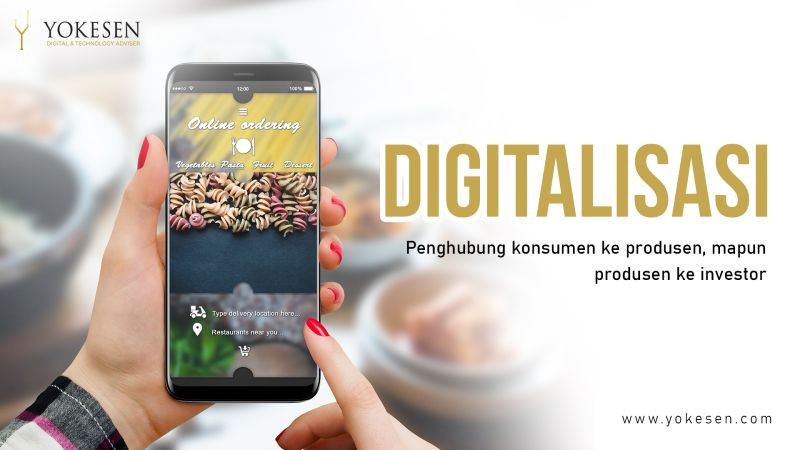
The number of Indonesian MSMEs has reached more than 63 million, and 98% of them are small/micro entrepreneurs. Ironically, even though MSMEs contribute 60% of this country's Gross Domestic Product (GDP), generally they are not included in the value chain or production value chain. Many of them don't even have a bank account and have access to micro business credit which can actually help develop their business.
The role of Digital Transformation in connecting farmers, consumers and investors. The role of technology is important in order to collect data, distribute data on farmers and small traders to parties such as buyers or investors (such as banks), whose locations are spread throughout the archipelago. That way they can enter the business value chain.
Digital applications, for example, can also become aggregators connecting several market accesses (such as farmers, prospective buyers to capital providers such as banks), which provides added value in the form of guaranteed certainty to all these parties.
Technological issues, which initially seemed alien when compared to those engaged in agriculture, can now begin to enter the business ecosystem. So that later farmers can become part of the sharing economy.
Simply put, the sharing economy is the use of technology to facilitate the exchange of access to goods, services and value between two or more parties. The sharing economy business trend is nothing new. However, thanks to developments in technology and the internet, transactions can be carried out very easily.
Application platforms such as Gojek for example. The Gojek platform is very helpful for motorbike drivers who want to earn additional income while being supported by a company that has a good reputation and large exposure. These motorbike drivers enter the sharing economy value chain by utilizing technology.
Meanwhile, in the agricultural sector, applications such as TaniHub and TaniFund have started to collaborate with farmers and vegetable and fruit traders so they can enter the larger sharing economy.
Also read The Role of Digital Transformation in Disruptive Industries
Sep 29, 2021